
Best Mattress for Couples: Finding Comfort When Sleep Preferences Differ
Updated: Sep 28

Key Takeaways:
Couples usually clash over firmness, temperature, or motion transfer, not personal taste, so identifying which one affects your bed matters more than price or brand.
Elvaé's three collections solve different levels of mismatch: 4-2 for couples with a wide gap, such as a big weight difference, 3-2 for couples whose preferences are close but not identical, and 3-1 for couples who already know their firmness and want to choose it directly instead of flipping a shared mattress.
Talalay latex helps couples specifically because it absorbs movement close to where it happens and stays breathable, so two different body types get even pressure relief without disturbing each other's sleep.
According to a 2023 SleepFoundation.org survey, 52.9% of couples who tried sleeping in separate beds said it improved their sleep quality, which says less about the relationship and more about how much a mismatched mattress setup affects sleep.
Sharing a bed sounds simple, but it rarely is once two different sleepers get involved. One partner wants a firm surface. The other wants to sink in. One runs hot all night. The other reaches for a blanket in July. These differences are common, and they are exactly why so many couples struggle to agree on a mattress.
Below is a look at Elvaé's three current mattress collections to help you find the best mattress for couples. Each one is built differently, not just firmer or softer, so the right pick usually comes down to how far apart your preferences are and how much construction you want working underneath you.
Best Mattresses for Couples: Elvaé's Collections
Elvaé 4-2 Mattress
The 4-2 collection is Elvaé's flagship dual-sided line, offered in three named firmness picks: Couture (Plush), Elite (Medium), and Luxe (Firm). What sets it apart from the other two collections is a dedicated high-density foam transition layer sandwiched between two separate Talalay latex layers, on top of a New Zealand wool comfort layer and a 5-inch foam foundation. That extra layer gives 4-2 more depth and structure than 3-2 or 3-1, which makes it the strongest option for couples whose preferences are genuinely far apart, such as a much heavier partner paired with a much lighter one, since there's more material working to keep both bodies properly supported on the same surface.
Elvaé 3-2 Mattress
The 3-2 collection is also dual-sided and offered in three named firmness picks, Amour (Plush), Belle (Medium), and Encore (Firm), but it skips the extra high-density transition layer found in 4-2. It still layers two sections of Talalay latex over a New Zealand wool comfort layer and a foam foundation, just with a leaner construction overall. That makes it a good fit for couples whose preferences sit close together rather than far apart, since Belle Medium in particular is built to blend noticeable sinkage with firm support without needing the deeper stack that 4-2 relies on for bigger gaps.
Elvaé 3-1 Mattress

The 3-1 collection is built differently from the other two collections. It's a no-flip design offered directly in three named firmness picks, Chic Plush, Chic Medium, and Chic Firm, and it leans on thicker memory foam transition layers instead of a second Talalay layer or a wool comfort layer. That makes it Elvaé's most direct option, positioned on-site as the "Essential" tier, for couples who already know their ideal firmness individually and would rather each choose that exact feel up front, instead of sharing one dual-sided mattress and flipping it to compromise.
At a glance: 4-2 offers the deepest, most engineered construction for couples with a wide comfort gap, 3-2 offers a simpler dual-sided build for couples who are close but not identical, and 3-1 skips the flip entirely so each partner can buy their exact firmness outright.
Why One Mattress Can Feel Different to Two People
Every body responds to a mattress differently. Weight, sleep position, and body temperature all change how the same surface feels. A mattress that feels supportive to a lighter side sleeper can feel completely different under a heavier back sleeper on the same side of the bed. That is not a matter of taste. It is physics, and it is why picking "something in the middle" so often leaves one partner unhappy.
The Three Most Common Conflicts Between Partners
Most couples run into some version of the same three issues. One partner wants cushion and pressure relief while the other wants a firmer, more supportive feel. Add in a hot sleeper paired with a cold sleeper, or a restless partner who wakes the other up every time they roll over, and you have most of what causes friction between two people in one bed. Finding the best mattress for couples with different preferences usually comes down to identifying which of these three conflicts affects your bed the most, rather than picking a mattress based on price or marketing alone.
Understanding where each partner actually falls in a plush vs firm mattress comparison is usually the first real step toward solving this, rather than guessing based on price or how a mattress looks in a showroom.
According to a 2023 SleepFoundation.org survey, 52.9% of couples who tried sleeping in separate beds said it improved their sleep quality. That says less about the relationship and more about how often the wrong mattress setup is quietly working against both partners.
Motion Isolation Matters More Than People Think
If one partner tosses, turns, or gets up during the night, a mattress with poor motion isolation lets that movement travel across the entire surface. This is one of the biggest differences between latex and memory foam. Dense, responsive latex absorbs movement close to where it happens, so a restless partner is far less likely to wake the other one up.
Temperature Keeps the Peace
Temperature disagreements are one of the most common and most avoidable sources of nighttime friction. Heat-trapping materials make the problem worse for a hot sleeper, no matter what the thermostat says. Reviewing a mattress's cooling features before buying saves both partners months of kicked-off blankets and stolen covers.
Pressure Relief and Firmness Balance
This is where most couples get stuck, because firmness feels different depending on body weight and sleep position, not personal preference alone. A closer look at the comfort and support factors that shape a mattress's performance explains why the same bed can feel firm to one person and soft to another.
Why Hand-Crafted Talalay Latex Works Well for Two Different Sleepers
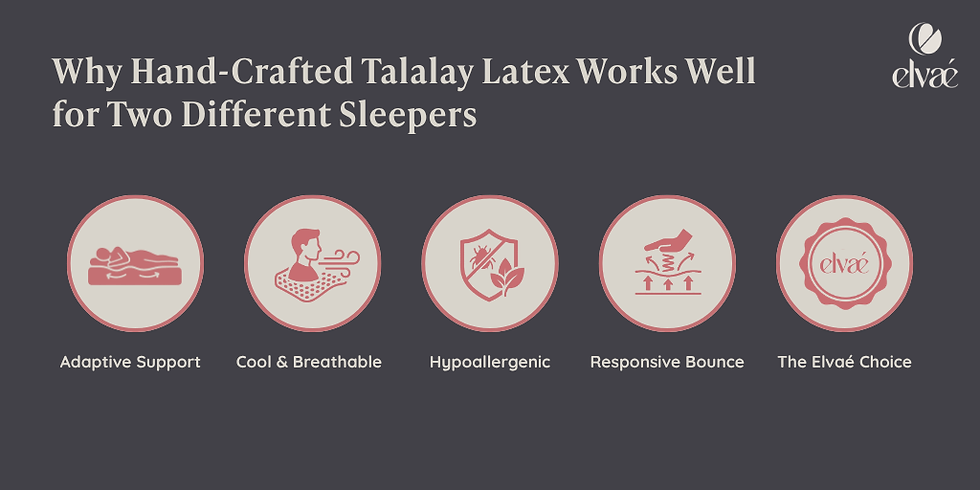
Natural Talalay latex stands out for couples because of how it responds to different bodies. It contours to the shape underneath it without losing support, stays breathable so heat doesn't build up the way it can in dense foam, and resists dust mites and mold, which matters if either partner has allergies. Because it responds quickly rather than slowly sinking, it also handles two different body types on the same surface more evenly than materials built around a single sleeper. This is one reason Elvaé builds its mattresses from natural Talalay latex instead of synthetic foam.
Final Thoughts
Most couples do not actually disagree about wanting a good night's sleep. They disagree because their bodies respond differently to the same surface, and a mattress built around one average sleeper was never going to satisfy either of them. Firmness mismatches, temperature battles, and getting woken up by a partner's movement are all solvable once you know what to look for instead of guessing at a showroom. Finding the best mattress for couples isn't about compromise. It's about knowing which conflict you're actually solving for.
Sleep better together with the right comfort match
Elvaé builds hand-crafted mattresses around exactly this kind of variation, using natural Talalay latex and offering Firm, Medium, and Plush comfort levels so two different sleepers can land on the feel that actually works for them. Elvaé brings four decades of Canadian craftsmanship to every mattress, built from natural materials rather than synthetic foam.
Contact us today to talk through which comfort level fits how you and your partner actually sleep.
FAQs
What type of mattress is best for couples with different firmness preferences?
Look for a mattress line that offers distinct comfort levels, such as firm, medium, and plush, rather than a single fixed feel. Talalay latex adjusts well to different body weights and sleep positions on the same surface.
Does a latex mattress help with motion transfer?
Yes. Latex is dense and responsive, which means it absorbs movement close to where it happens instead of letting it spread across the mattress, so a restless partner is less likely to disturb the other sleeper.
Can one mattress work for a hot sleeper and a cold sleeper?
A breathable material like natural latex, paired with wool and cotton layers, helps prevent heat buildup for the partner who sleeps hot without making the mattress feel cold to the other person.
How do I know what firmness level is right for both me and my partner?
Firmness feels different depending on body weight and sleep position, not personal taste alone. Side sleepers and lighter partners often lean toward medium or plush, while back and stomach sleepers or heavier partners often prefer firm support.
Is a split mattress necessary for couples with very different needs?
Not always. A well-chosen medium comfort level, built from a responsive material like latex, often bridges the gap between firm and plush preferences. Some hand-crafted, dual-sided mattresses also let couples flip between two firmness options rather than replacing the mattress entirely.
What is the best mattress for couples with different weights?
Look for strong pressure relief over a supportive core, since body weight changes how deep each partner sinks into the same mattress. Heavier partners often do better on firm or medium comfort levels, while lighter partners tend to prefer medium or plush, so checking each partner's ideal firmness by weight matters more than choosing one setting for the whole bed.


Comments